
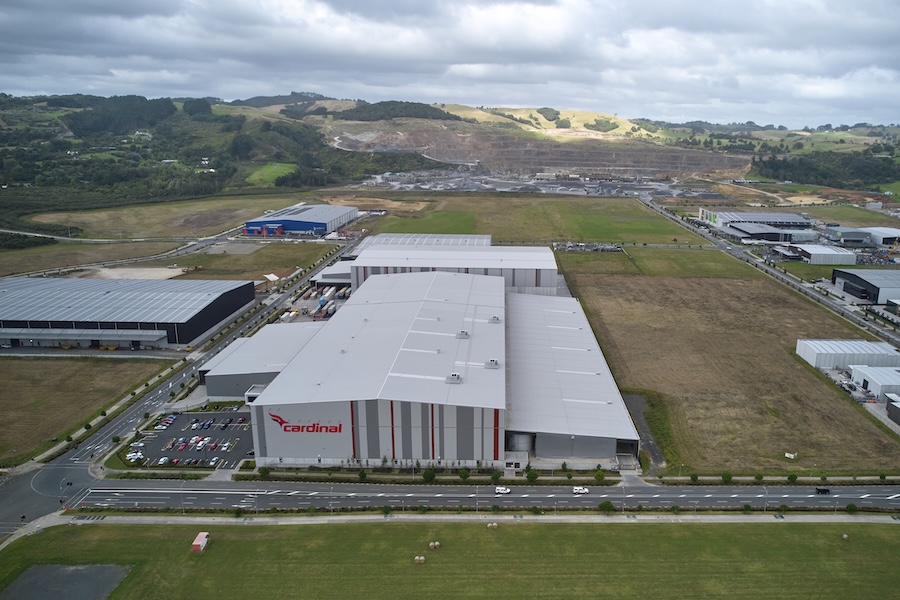
Pictured above: Drury South.
A sustained lift in New Zealand’s primary exports is driving a new wave of investment into industrial property, with hundreds of millions of dollars expected to flow into logistics, cold storage and distribution developments as exporters scale up capacity to meet global demand.
Latest Ministry for Primary Industries forecasts show food and fibre export revenue is expected to reach $62 billion in the year to June 2026, marking steady growth of around 3 percent on the previous year and roughly 16 percent over the past two years.
That growth is being led by core export sectors including dairy, meat, forestry and horticulture, and is increasingly reshaping demand for industrial infrastructure across the country.
Calder Stewart director of property Ben Stewart says the scale of current and planned development activity reflects a structural shift in how export supply chains are operating.
“If the pipeline we are seeing across the country progresses as expected, our development activity could easily double over the next three to five years,” he says.
Over the past three years, the company has delivered more than $1.5 billion in industrial projects, covering over 750,000 square metres of warehouse and logistics space nationwide.
Stewart says the biggest pressure point is cold storage, driven directly by export volumes in dairy and meat.
“When primary production is strong, the entire supply chain has to scale with it. That means more staging facilities, more temperature-controlled storage, and more sophisticated distribution networks.”
He says Auckland is also experiencing significant change, not only from exporters but from major retailers and industrial suppliers consolidating their networks into larger, more automated hubs.

Ben Stewart.
A recent example is NZ Safety Blackwoods’ 18,000 square metre distribution centre at Drury South Crossing, which brings together multiple North Island operations and incorporates robotic storage and retrieval systems to improve efficiency and throughput.
Stewart says projects like this reflect a broader shift in industrial property design and function.
“We’re seeing a move away from multiple smaller sites towards centralised distribution hubs. At the same time, automation is increasing storage density and changing how these facilities operate day to day.”
The Drury facility, owned by Australian-listed Wesfarmers, also highlights growing investor confidence in modern industrial assets linked to essential supply chains, with the property sold in 2024 for $66.5 million and expected to revalue higher following its first assessment cycle.
Stewart says constraints on land availability, particularly in Auckland’s key logistics corridors, are also shaping development decisions.
“With limited greenfield sites in strategic locations, businesses are acting quickly when opportunities arise. That scarcity is driving larger, taller and more technologically advanced facilities.”
Those developments increasingly rely on vertical design and high-bay storage systems, allowing companies to maximise capacity on constrained land while maintaining speed and efficiency.
The broader expansion is also having flow-on effects for construction activity and employment. Calder Stewart currently employs more than 500 people nationally, with potential growth of up to 15–20 percent if the current development pipeline is realised.
Large-scale builds also generate significant demand for subcontractors, engineering specialists and trades during construction phases.
“These projects are not just buildings, they are long-term infrastructure that supports export performance and domestic supply chains at the same time,” Stewart says.
The company also holds around 900 hectares of industrial-zoned land nationwide, positioning it to respond to future demand as export-driven investment continues.
Further major developments are planned across Auckland and the South Island over the next two years, alongside long-term logistics and energy-integrated industrial precincts aimed at improving freight connectivity.
Stewart says the current cycle reflects long-term confidence in both export growth and the infrastructure required to support it.
“When companies are committing capital at this scale, particularly into automation and large-format facilities, it signals they expect sustained demand. That in turn reinforces the entire export ecosystem.”