
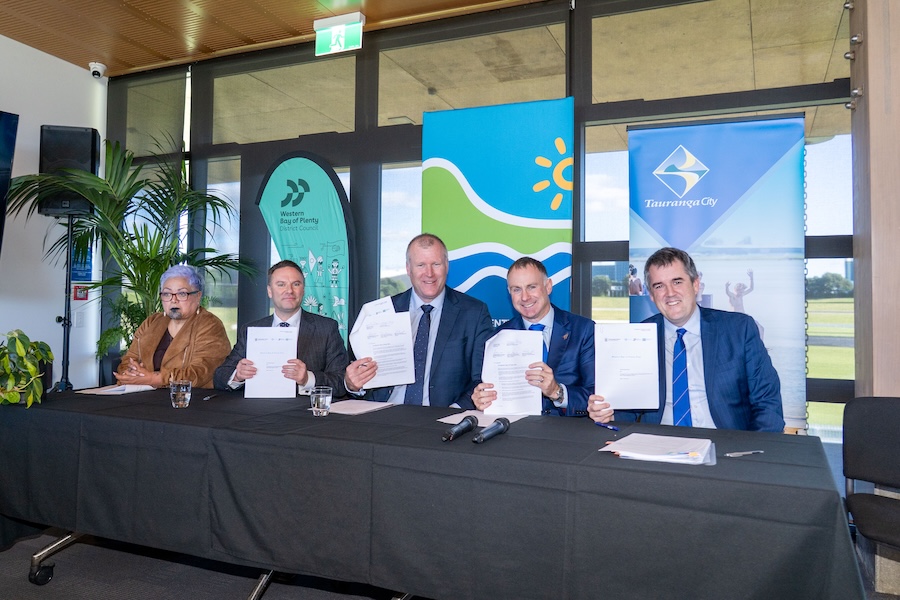
Pictured above: BOP Regional Council Chair Matemoana McDonald, WBOP District Council Mayor James Denyer, Tauranga City Council Mayor Mahé Drysdale, Minister Simon Watts, Minister Chris Bishop.
A new 10-year Regional Deal between central government and Western Bay of Plenty councils is set to direct more than $4 billion into the sub-region’s infrastructure — giving exporters, importers and investors long-sought certainty around the freight corridors and port links that move much of New Zealand’s primary produce to the world.
Exporters operating through New Zealand’s busiest port have been handed a decade of planning certainty, with the signing of a Regional Deal that formally recognises the Western Bay of Plenty as the country’s global trade gateway.
Announced on 14 May by Deputy Prime Minister David Seymour and Ministers Chris Bishop and Simon Watts, alongside regional leaders, the Deal brings central government together with Tauranga City Council, Western Bay of Plenty District Council and Bay of Plenty Regional Council in a coordinated, 10-year programme of infrastructure investment spanning transport, housing, health and education.
The numbers are substantial. The implied investment into the region over the 10-year period — through new and existing funding from both the Crown and the sub-region — is likely to exceed $4 billion across roading, water, health and education. Rather than a single new funding pool, the Deal pulls nationally and regionally significant projects into one coordinated programme with what its backers describe as a clear focus on delivery.
For the export and import sector, the significance lies less in the dollar figure than in the certainty it brings. The Western Bay is the conduit for a large share of New Zealand’s primary exports: around 80 percent of the country’s kiwifruit is grown in the region, and the bulk of it leaves the country through the Port of Tauranga, New Zealand’s largest port by trade volume. Strong economic growth — averaging 4.6 percent a year over the past decade — has placed mounting pressure on the roads, water, housing and services that keep that trade moving.
“This Deal reflects a strong partnership with central government to deliver the infrastructure for transport, housing and services our growing sub-region needs, and gives us greater certainty as we plan for the future,” says Tauranga Mayor Mahé Drysdale. “By aligning central and local government in these areas, we can make real progress on solving some of the biggest issues communities face.”
Western Bay of Plenty District Mayor James Denyer frames the Deal as a vote of confidence in the region’s trajectory. “Our communities need infrastructure that enables housing, alleviates congestion, and provides essential services. This can only be achieved by working together with central government, providing long-term certainty, and aligning future infrastructure investment. This Deal is a big win for the Western Bay of Plenty and signals confidence in our continued growth and economic development.”
Export growth a named priority
The Deal is organised around five themes — transport infrastructure, land and housing development, social infrastructure, export growth and economic diversification — several of which speak directly to exporters and freight operators.
Export growth is a priority in its own right, with an objective of improving productivity and freight efficiency along State Highway 2 and supporting key export sectors. Under the Deal, the sub-region will investigate an asset recycling programme that would attract a Crown funding uplift, provisionally earmarked to fund the “Connecting Mount Maunganui” package — State Highway and local roading upgrades around Hull, Hewletts and Totara — and the Katikati bypass. Both projects target long-standing freight bottlenecks on the routes serving the port. The Deal also commits to aligning local and national Recognised Seasonal Employer (RSE) worker housing rules to support projected kiwifruit growth, addressing a workforce constraint that has direct implications for harvest and export volumes.
On the transport side, the Government will prioritise Takitimu North Link Stage 2 between Te Puna and Ōmokoroa, and the widening of SH29A at Tauriko, while investigating tolling options to help fund the regional roading network. Regional leaders say a key outcome is greater certainty around Roads of National Significance, which shape planning and investment decisions over the next 10 to 30 years — certainty that lets the construction and development sectors build capability ahead of demand.
The economic diversification theme, meanwhile, commits the sub-region and the Crown to work together on opportunities across horticulture, robotics and automation, marine science and aquaculture, and freight and logistics decarbonisation — a signal that the region is positioning its trade infrastructure for a lower-emissions future.
A partnership built for the long term
The Deal also sets out to better support Māori economic development across land use, housing, procurement and business participation, with iwi, hapū and Māori Land Trusts named as partners alongside councils and the Crown.
“This is about getting the fundamentals right for the decades ahead, working together with government and our regional partners to lay foundations for a more connected, resilient and prosperous Western Bay of Plenty — a region where people and businesses can thrive,” says Matire Duncan, chair of SmartGrowth’s Combined Tangata Whenua Forum.
Bay of Plenty Regional Council chair Matemoana McDonald says the signing is a milestone rather than an endpoint. “Today marks an important milestone in our ongoing commitment to bring together all levels of government and our tangata whenua partners to work collaboratively in the long-term interests of the region. We are much stronger together.”
Projects under the Deal will be delivered over 10 years, with progress measured and reported publicly. For exporters weighing where to invest, consolidate or expand, the message from regional leaders is that the freight corridors underpinning New Zealand’s trade gateway now have a plan — and a decade of committed backing — behind them.